ASTM E2018-24 Property Condition Reports
Walk the building. Upload the evidence. Review the draft.
A PCA takes a day on site and a week at the desk. Baseline PCR turns the walkthrough's photos, notes and owner documents into a complete E2018-24 draft with Table 1 and the replacement reserve built and sourced. Your engineer reviews, edits and signs.
First job free, no card. Then $99–$349 per draft by building size, or $499/month for firms.
- 11 + 2
- E2018 system sections drafted, plus ADA and moisture screens
- 0
- costs without a stated quantity, unit cost and source
- 1
- signature required before anything is issued: yours
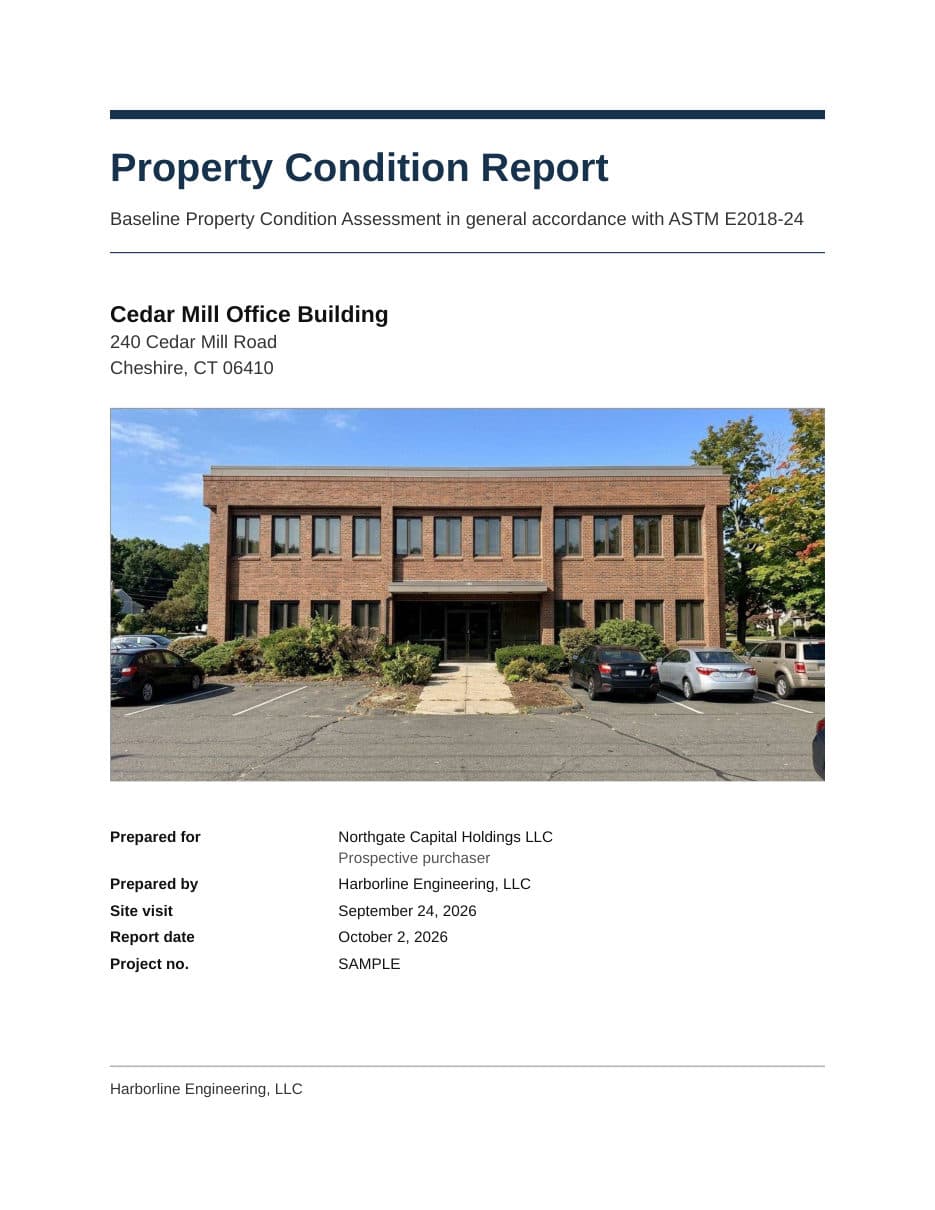
Pages from the sample report. Fictional property; real output.
- ASTM E2018-24
- cited by section throughout; standard paraphrased, never reproduced
- HUD CNA e-Tool EUL
- the published useful-life table, Fannie 4099.F values carried where they differ
- Quantity × unit cost
- every figure in Tables 1 and 2, with a basis sheet stating the arithmetic
- Not observed / not provided
- what missing evidence prints as; never a guess
- Reviewer signs
- nothing issues without approval; the PDF says AI-assisted
Three steps, one of which you already do
The site visit does not change. The desk work, drafting the narrative, computing the tables and assembling the appendix, is what the engine takes on. Judgment stays with the reviewer.
- 1Site day, as now
Walk the building
Take the photographs you already take. Dictate or type field notes in your own shorthand. Send the owner's contact the pre-survey questionnaire link so the answers arrive before you do.
Nothing to learn on site. The notes in the sample job are the field observer's real shorthand.
- 2Minutes
Upload the evidence
Photos are classified to the E2018-24 building systems and checked against the section 9.3 photograph minimums. Owner documents are read: certificates, warranties, invoices, prior reports, rent rolls. Notes become observations, deficiencies and reserve items.
Clicking Draft report is the one paid step, priced by building size and shown first; the first job is free. Each fact keeps its source: observed, reported or documented.
- 3The desk day, shortened
Review the draft
A complete draft: executive summary, systems summary, Table 1 and Table 2 with a basis for every line, the narrative for all eleven system sections (E2018's ten, with roofing on its own), document review, limiting conditions and a captioned photo appendix. Edit anything; totals recompute as you type.
Approve, and the signed PDF goes out by share link or email with a reliance letter if the engagement needs one.
The complete Cedar Mill sample job, evidence and all, is in your account from the first sign-in, so you can run step 3 before you have done steps 1 and 2. Help centre
Where the reviewer works
The draft opens in a workspace built for a PE, not a chat window: the narrative for every section, the cost tables as editable rows, the photographs, and a preview of the PDF, with the engine's checks beside them.
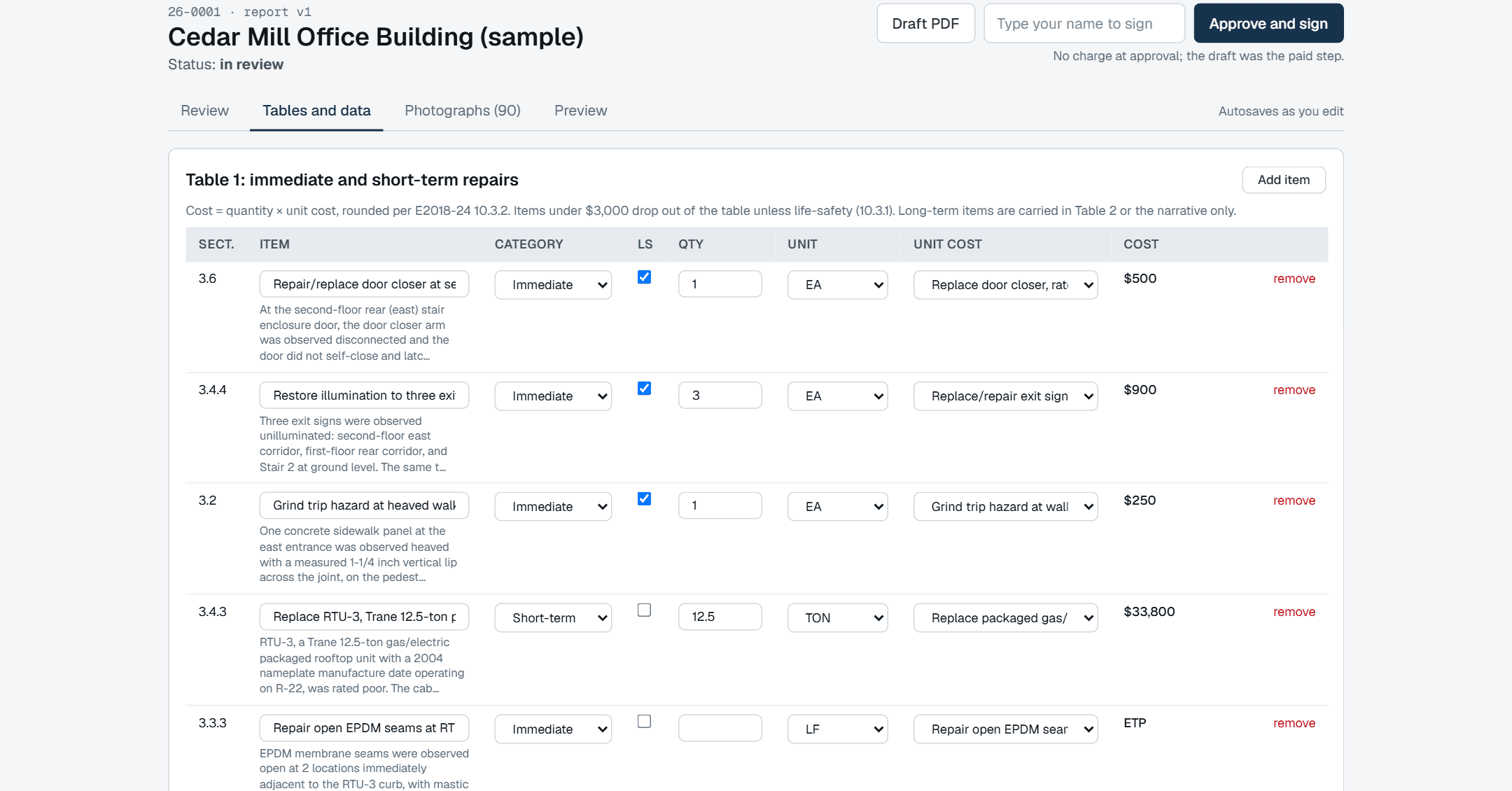
- Tables you edit, not retype
- Change a quantity, pick a different unit cost from your library or type your own, move an item between immediate and short-term; Table 1, Table 2, the systems summary and the executive summary totals recompute as you type.
- The engine's findings, in the open
- Unmeasured quantities, unsourced ages, items dropped below the threshold, a number in the prose that is not in the data: each is listed for the reviewer, and an error blocks approval until it is resolved.
- Every fact with its source
- Observed, reported by the contact, or documented; the source tag travels with the fact from the notes to the PDF, so the reviewer can see what rests on a manager's recollection.
- Photographs where they belong
- Reassign a photo to another system, fix a caption, or exclude one; the report's sections and Exhibit A follow.
Built to survive a lender's reviewer
A PCR is read by people looking for the sentence they can challenge. The engine is designed around the failure that would end the product: a fact above a PE's signature that nobody supplied.
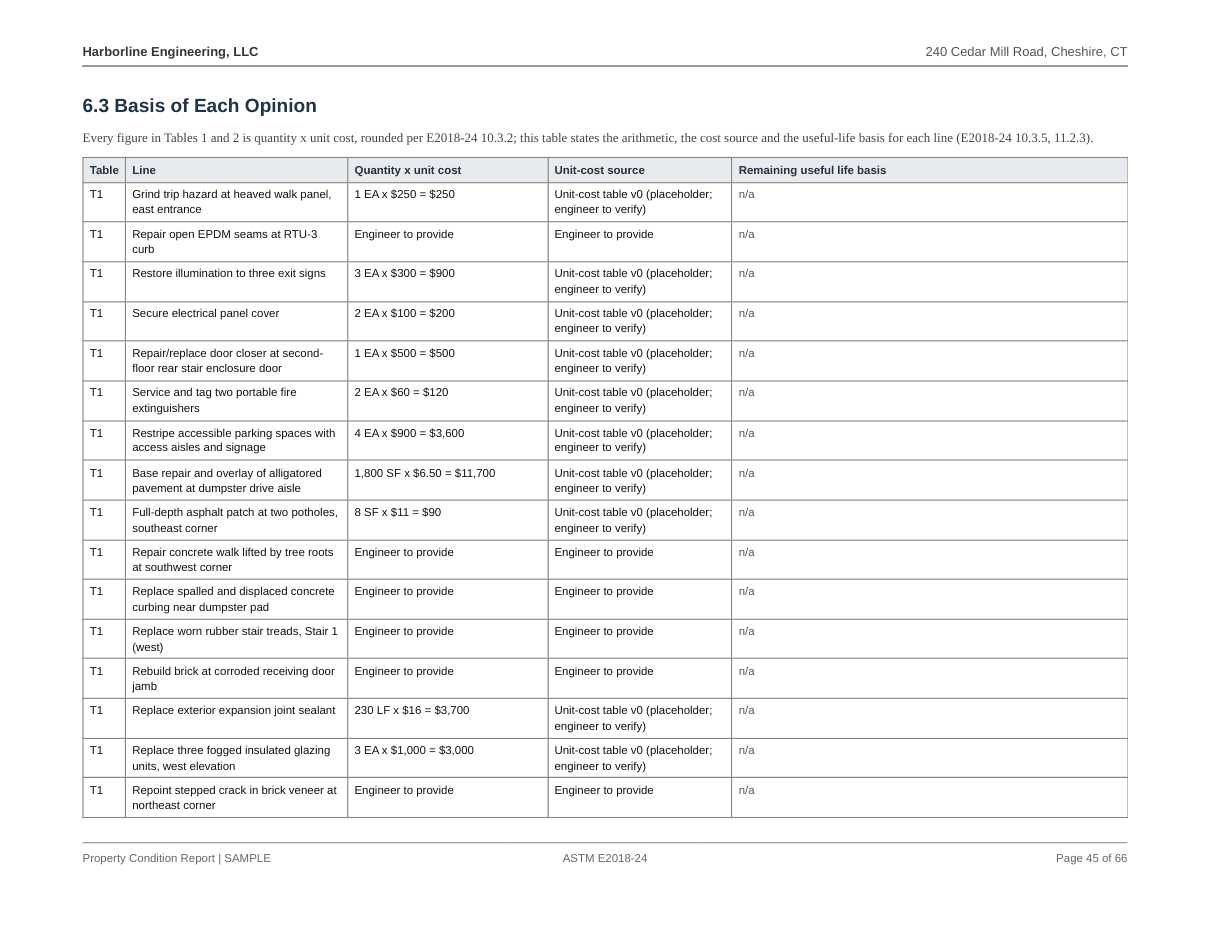
- A basis for every dollar
- Each line in Table 1 and Table 2 is quantity × unit cost from your firm's own library, and the basis sheet prints the arithmetic, the cost source and the useful-life reasoning. A quantity nobody measured prints as engineer to provide, never as a round number.
- It refuses to invent
- Numbers in the narrative must exist in the data. Quantities must appear in the notes, questionnaire or documents. Missing evidence prints as not observed or not provided. A photo identifier never reaches the prose. Each rule is a test, not a promise.
- Observed, reported, documented
- Every age, date and condition keeps its source. A warranty date is documented; a manager's recollection is reported; a nameplate is observed. The report says which, in the words a lender's reviewer expects.
- Tables the way lenders read them
- Landscape cost sheets grouped by system, immediate and short-term segregated per 10.3.7, the reporting threshold applied and disclosed per 10.3.1, the reserve by calendar year with inflation compounding from the report year.
- The reviewer sees what the engine saw
- A checklist keyed to E2018-24 section numbers, the engine's own findings (unmeasured quantities, unsourced ages, dropped items) and the source of every fact, all beside the editable text. Edits recompute the totals live.
- Your firm's report
- Letterhead, logo, colour, licence line, reliance and limiting-conditions boilerplate, unit-cost library, defaults for threshold, period and inflation. The engine writes; the report is yours.
Priced at a few percent of the fee
Report writing is the largest share of a PCA's hours: a four-to-seven-hour site visit followed by days at the desk drafting narrative, computing the tables and assembling the appendix. Baseline PCR charges once per job, when you draft it, sized by the building, against a fee in the thousands.
Uploading and evidence processing are free; the first job is free. After the draft, editing, new versions, approval and delivery cost nothing more, and a draft that fails is credited back.
Fee ranges from consultancies that publish them; see how much a PCA costs for the sources.
| Assessment | Typical fee | Baseline PCR |
|---|---|---|
| Small building up to 25,000 SF, one building | $1,500 – $4,000 | $99 |
| Medium building or small portfolio 25,000 to 100,000 SF, or 2 to 4 buildings | $4,000 – $10,000 and up | $199 |
| Large or multi-building property over 100,000 SF, or 5+ buildings | well above $10,000 | $349 |
The whole report, in the order E2018-24 asks for it
Section 11 of the guide lists what a Property Condition Report contains. The draft produces every part, and each heading in the PDF carries the clause it satisfies, so a lender's reviewer can check coverage without reading the standard beside it.
| Report section | E2018-24 | Drafted from the evidence |
|---|---|---|
| 1Executive Summary | 11.4 | General description, findings and opinions, deviations, further study, the two table totals |
| 2Purpose, Scope and Methodology | 11.5, 10 | User and purpose, walk-through scope, condition terms, cost methodology, reliance |
| 3System Description and Observations | 11.6, 9.4.1–9.4.10 | Site through interiors: description, age basis, observations, what was reported, what was not observed, recommendations |
| 4Additional Considerations | 11.8, X2 | Abbreviated accessibility screen and moisture observations, identified as out-of-scope supplements |
| 5Document Review and Interviews | 11.7 | Each document with its material information, documents requested and not provided, interview statements |
| 6Opinions of Cost | 10.3, X1.2.5 | Table 1 immediate and short-term, Table 2 replacement reserve by year, basis of each opinion |
| 7–9Out of Scope, Qualifications, Limiting Conditions | 11.8, 11.9, 11.10 | Field observer and reviewer named, every condition that limited observation |
| 10Exhibits | 11.11, 11.3 | Numbered, captioned photographs in report order; questionnaire and owner documents |
Plain E2018-24 baseline PCR today. Fannie Mae Form 4099, Freddie Mac and HUD PCNA formats are on the roadmap; the structured data already carries the fields they need. Standards summaries
Read the sample before you sign up
Cedar Mill Office Building: a fictional 1985 two-storey, 24,300 SF multi-tenant office assessed for a purchaser. Ninety photographs, seven owner documents, the observer's shorthand notes and a questionnaire in; the complete PCR out. The property is invented; the pages below are the real output.
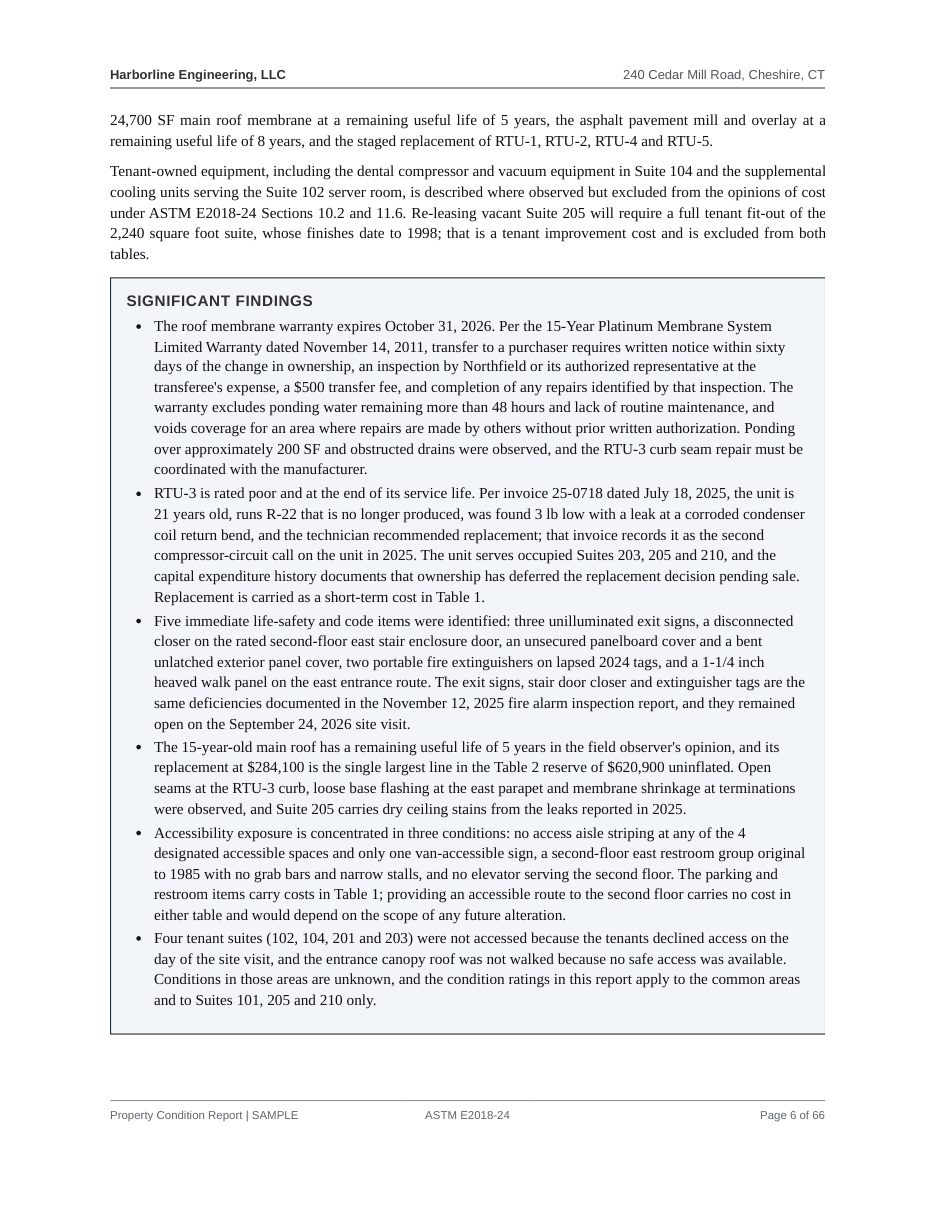
What a lender's analyst reads first, on page 6
Six paragraphs the engine writes from the finished sections: the roof warranty expiring a month after the site visit and what its transfer requires, the rooftop unit on R-22 with a documented active leak, five open life-safety items from a fire alarm inspection nobody closed, the four suites not accessed. Every sentence traces to a document, a note or a photograph.
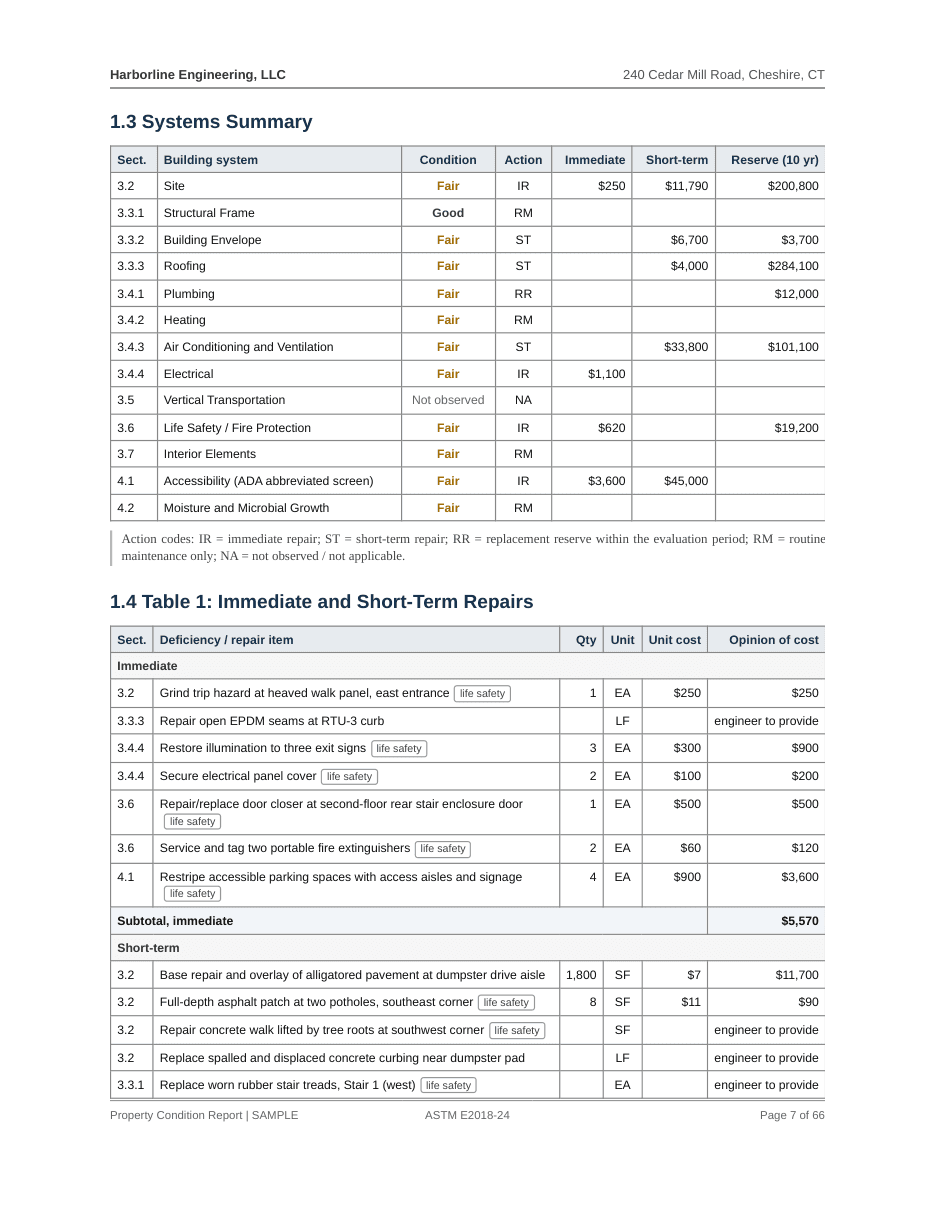
Every system, its rating, its action code, its cost
Condition in the guide's defined terms, an action code (immediate, short-term, reserve, routine maintenance, not observed) and the immediate, short-term and ten-year reserve totals per system, followed by Table 1 in summary form. The reviewer changes a rating in the workspace and this page changes with it.
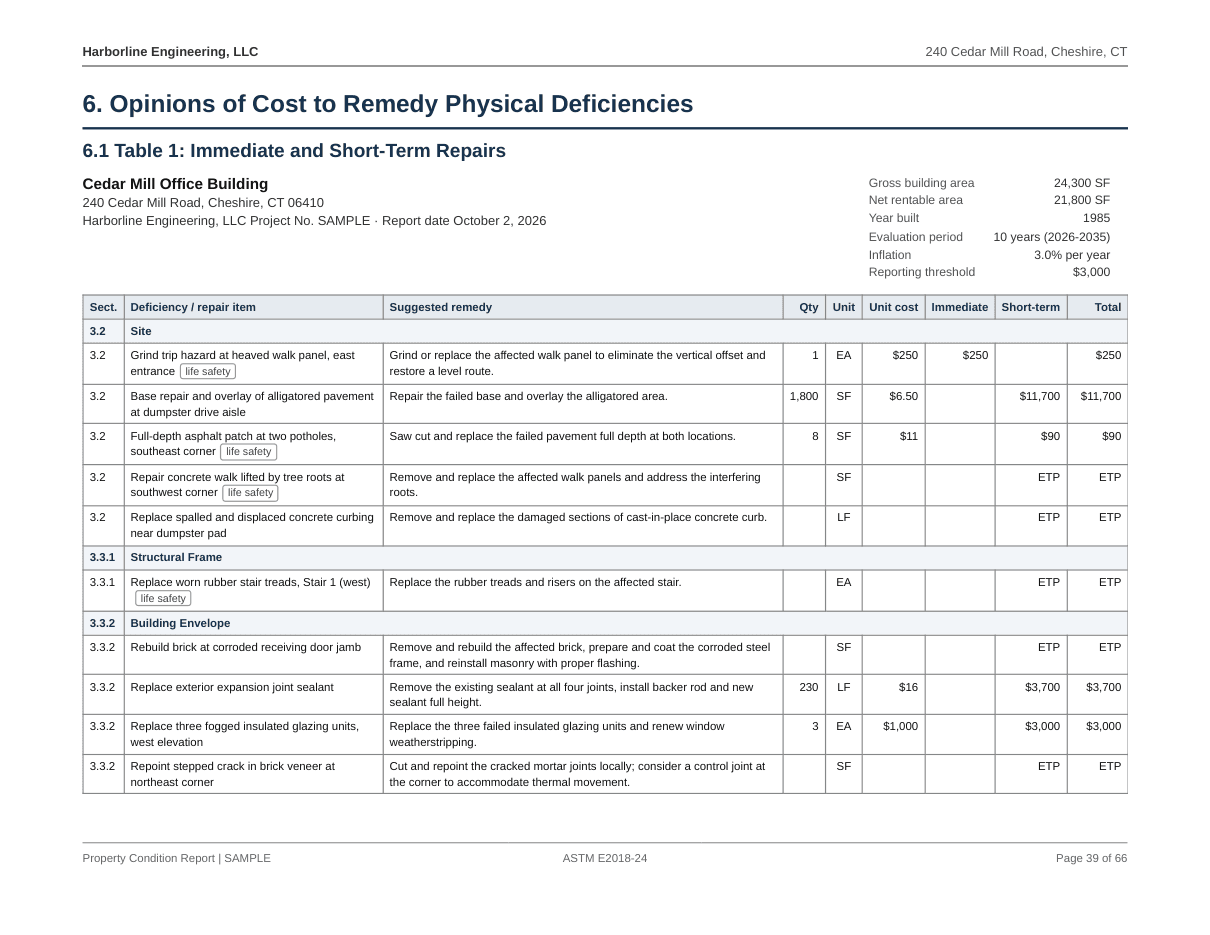
Immediate and short-term, grouped by system, landscape
Each line carries the suggested remedy, quantity, unit, unit cost and the cost in the column its category earns. Items under the reporting threshold are listed by name at the foot as routine maintenance, life-safety items below the threshold are retained, and the rules applied are printed, per E2018-24 10.3.1 and 10.3.7.
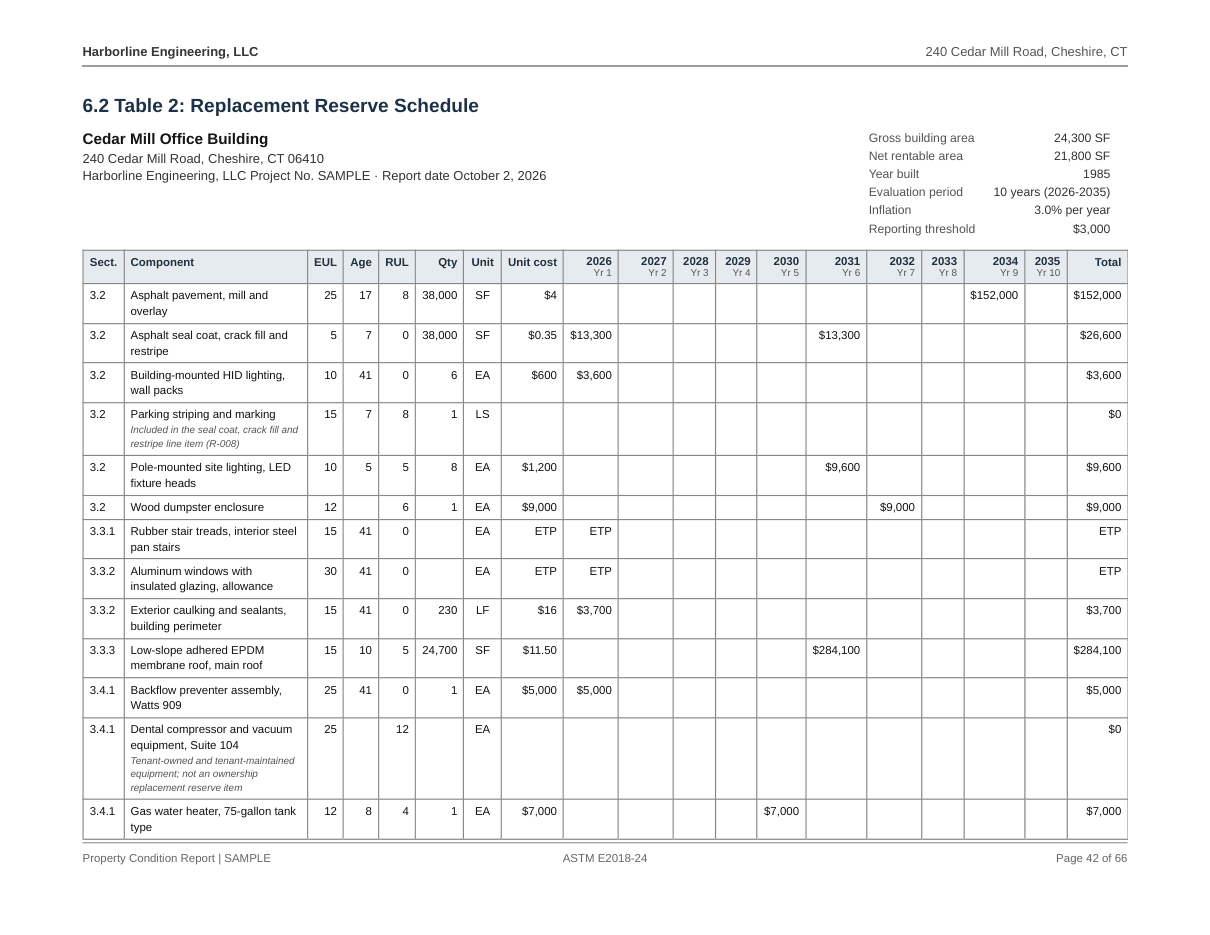
The replacement reserve, year by year
Expected useful life from the HUD table, age, remaining useful life (the field observer's opinion where stated, with the reason printed), quantity, unit cost and the cost in the calendar year it falls, uninflated and inflated. An unpriced component still lands in its year, marked engineer to provide, so nothing silently disappears from the schedule.
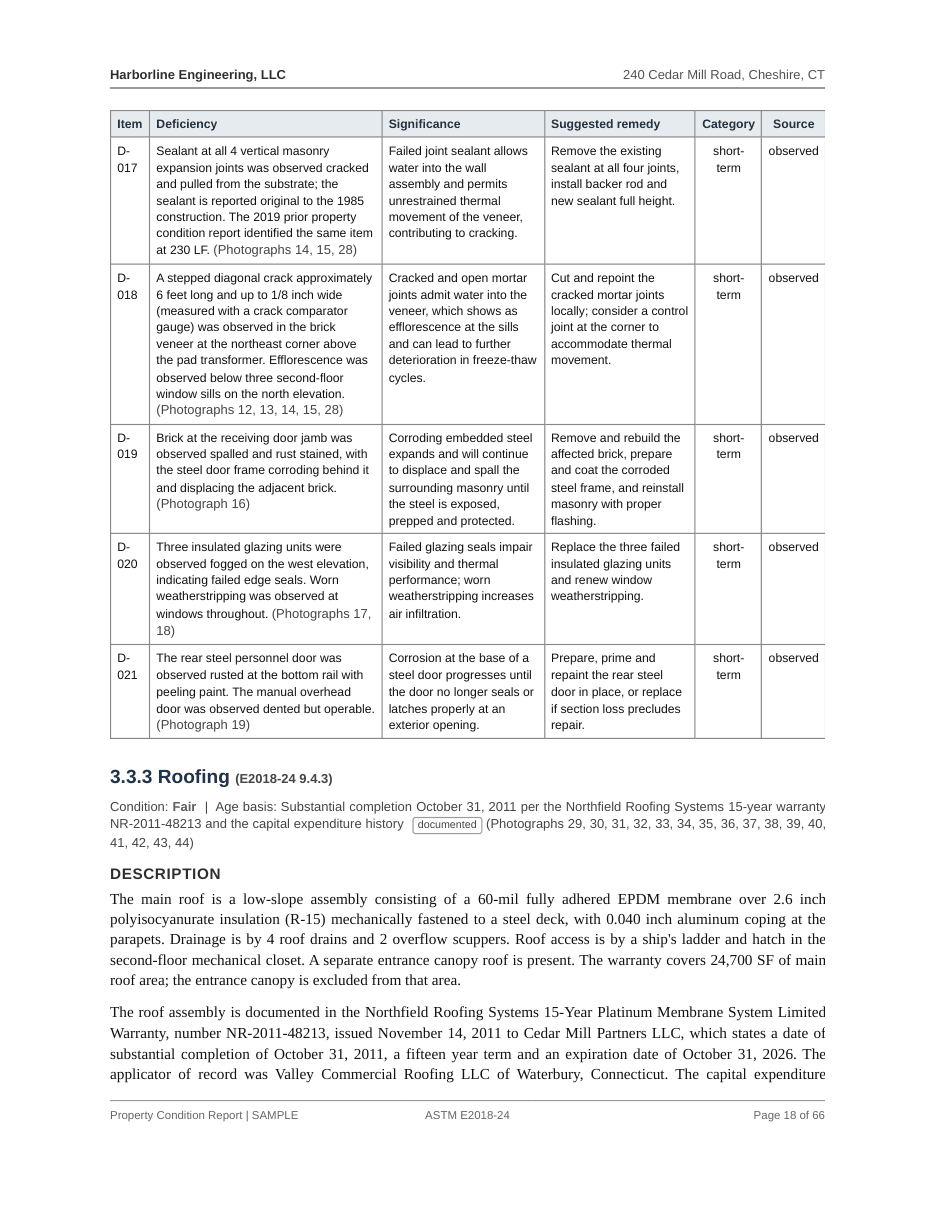
Roofing: description, observations, recommendations
The roof's age from the warranty (documented), the leaks from the manager (reported), the open seams at the RTU curb (observed) and what each means. Recommendations name the remedy and the table that carries the cost, or call the item routine maintenance. The deficiency table under the prose is the structured record the tables were built from.
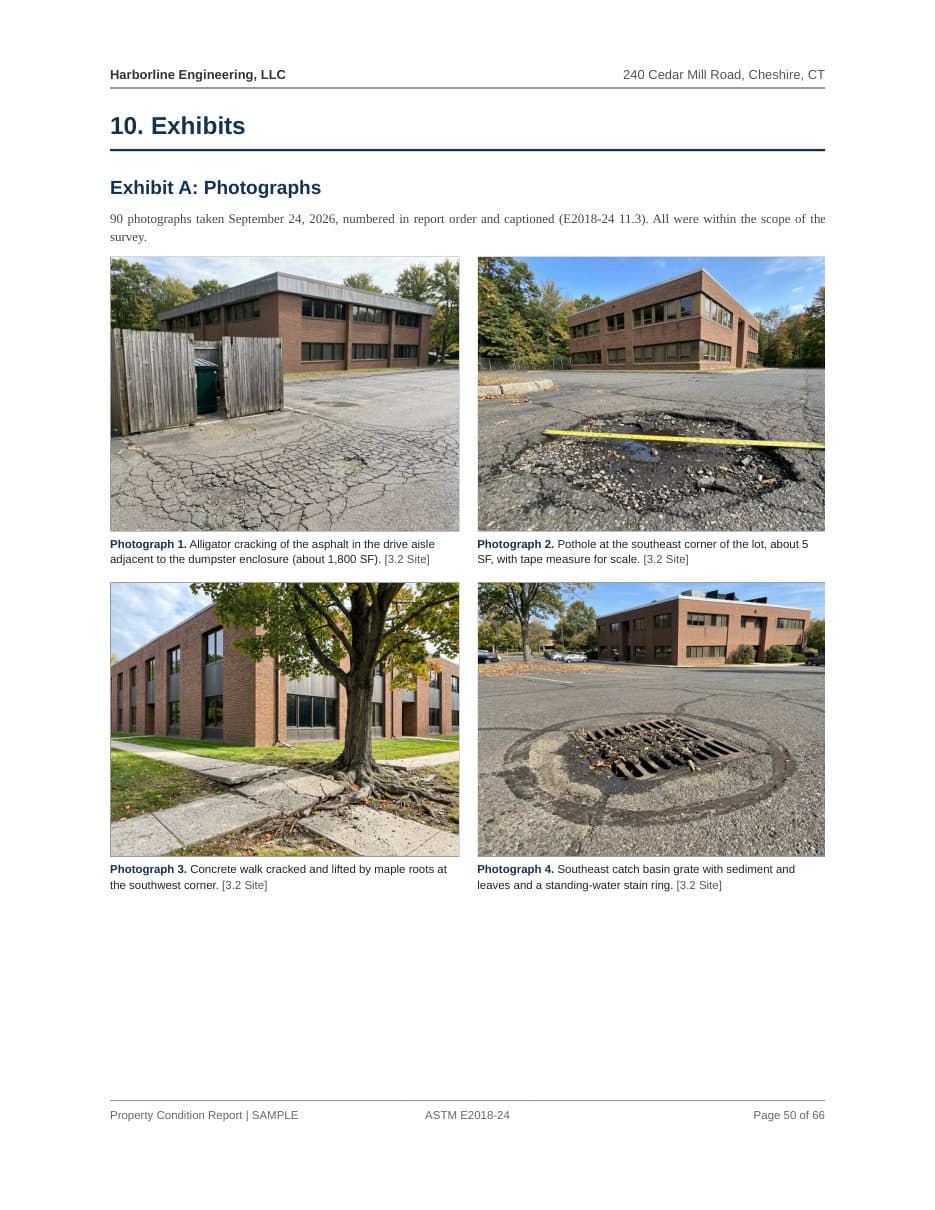
Numbered, captioned, in report order
Photographs are classified to a system on upload and referenced from the sections that discuss them, then collected in Exhibit A with captions. The engine checks the set against the guide's section 9.3 minimums and tells the reviewer what is missing before the report goes out.
Built for the firm that signs it
Engineering consultancies
Two to fifty people writing PCAs for buyers and lenders alongside structural, MEP or environmental work. The PE who signs gets a draft with the tables already built and every fact sourced, and spends the desk time on judgment.
Architecture and due-diligence firms
Acquisition and refinance assessments where the client wants the E2018 table of contents and the lender wants Table 1 and the reserve. Your letterhead, your boilerplate, your unit costs.
Commercial inspection firms
Firms moving from checklist inspections to baseline PCAs under E2018-24. The structure, the citations and the cost discipline are built in; the field process is the one you already run.
Two ways to pay, one price per job
The draft is the paid step. You pay once per job, sized by the building, or subscribe if you do several a month. Your first job is free with no card.
Charged once, when you click Draft report. Editing, new versions, approval and delivery are free after that. No subscription.
| Small building | up to 25,000 SF, one building | $99 |
| Medium building | 25,000 to 100,000 SF, or 2 to 4 buildings | $199 |
| Large building | over 100,000 SF, or 5+ buildings | $349 |
The intake form sets the size from gross area and building count; the price is printed under the draft button before you click it.
5 drafts a month of any size, $79 each after that. Unlimited users. 15% off paid annually.
- ■Worth it from about three drafts a month
- ■One predictable line on the firm's books
- ■Cancel any time from Billing; no automatic conversion from the free draft
Every plan includes
- ■Unlimited photos and documents per job, classified on upload
- ■Structured extraction, Table 1 and Table 2, full narrative, photo appendix
- ■Reviewer workspace with the E2018-24 checklist and the engine's checks
- ■Your unit-cost library, letterhead, colour and boilerplate
- ■Share links, email delivery, reliance letters
- ■The Cedar Mill sample job in your account from day one
No surprises
A draft that fails or is not usable is credited back. AI usage is included; there is no per-token meter. The sample job is never charged. Questions: hello@baselinepcr.com.
Questions engineers ask
- Is the report AI-generated?
- No. It is AI-assisted. The engine drafts from your evidence and every sentence is editable. A licensed reviewer at your firm approves and signs; the PDF states that it was prepared with AI assistance and reviewed by the named engineer, and nothing is issued without that approval.
- Where do the costs come from?
- Every line is quantity × unit cost. The unit cost comes from your firm's own library; we seed a placeholder table calibrated to published assessments and mark it as such until you replace it. A quantity that was not measured prints as engineer to provide, and the basis sheet prints the arithmetic and source for every figure.
- What does it refuse to do?
- Invent a fact. Missing evidence prints as not observed or not provided, never as a guess. Numbers in the narrative must exist in the data; quantities must appear in the notes, questionnaire or documents; photo identifiers never reach the prose. Each of these is a test in the codebase, and the reviewer sees every finding.
- Which standard, and which formats?
- ASTM E2018-24, cited by section throughout and paraphrased rather than reproduced. Fannie Mae Form 4099, Freddie Mac and HUD PCNA formats are on the roadmap; the structured fields already carry what they need.
- Can I keep my template?
- Firm settings hold your letterhead, logo, colour, licence line, defaults for threshold, evaluation period and inflation, and your reliance and limiting-conditions boilerplate. The report follows the E2018 sample table of contents that lenders and buyers already know.
- How long does a draft take?
- Roughly ten to fifteen minutes for a job the size of the Cedar Mill sample (ninety photographs, seven documents), less for smaller jobs. You get an email when the draft is ready, and the sample job is already drafted in your account so you can start reviewing immediately.
- Who owns the reports and the evidence?
- Your firm. Evidence and reports are stored per organisation, removable by you, and never used to train models. The privacy policy and data processing addendum in the legal section say exactly what is processed and by whom.
- When am I charged, and what if the draft is no good?
- Once per job, when you click Draft report; the price is printed under the button first. Editing, new versions, approval and delivery are free after that. A draft that fails or is unusable is credited back to your firm as a free draft, and refunded where money moved.
Written for the people who sign PCRs
Guides, comparisons, standards summaries and a glossary of E2018-24 terms, each cited to its source. The standard is paraphrased, never reproduced.
The E2018-15 to E2018-24 changes that alter how a PCR is written: immediate and long-term costs, observation, user scoping, referenced documents, accessibility.
How E2018-24 defines the condition terms relative to the reporting threshold, how to rate a system with mixed components, how the systems summary uses ratings.
How to brief a buyer or owner on a PCR they will not read end to end: what the tables mean, what is an opinion, what to negotiate, what to escrow.
Typical PCA fees by building size and complexity, what pushes a fee up, how firms price the report versus the site day, and where drafting time goes.
The three formats a commercial PCR can take, what Fannie Mae 4099 and the HUD PCNA add to the ASTM baseline, who requires which, and why ASTM comes first.
The two agency multifamily PCA formats differ in form, repair taxonomy, reserve horizon and consultant rules. What each requires on top of ASTM E2018 and.
The PCR reserve table and an HOA reserve study both forecast replacements, but E2018 says one is no substitute for the other. Scope, method, funding, preparer.
Physical deficiency, remaining useful life, reporting threshold, user, field observer and the rest, each with the clause it comes from.
Your first draft is free
Sign up, open the Cedar Mill sample already in your account, and run a job of your own. No card. The reviewer signs before anything is issued.